

In tile laying projects, the application effect of tile adhesive directly determines the firmness, durability and overall aesthetics of tile laying, and is one of the core links to ensure decoration quality. To give full play to the bonding performance of tile adhesive, it is necessary to conduct refined control over the core factors affecting its effect, which can be analyzed in detail from the following four dimensions:
1. Base Layer Condition: The "Solid Foundation" for Tile Bonding
The base layer is the connecting carrier between the tile adhesive and the main building structure, and its quality directly determines the stability of the tile adhesive's bonding effect, which needs to meet the three requirements of "strength, flatness and cleanliness".
- Reaching Strength Standard: The compressive strength of the base layer (usually concrete or cement mortar layer) must not be less than 1.5MPa. If there are problems such as sanding, pulverization and delamination, the tile adhesive will not form an effective bond with the base layer, and problems such as tile hollowing and falling off are likely to occur in the later stage. For example, if the base layer of an old wall is directly used for tile laying without treatment, the tiles will probably become loose within 3-6 months.
- Compliant Flatness: The flatness error of the base layer surface must be controlled within 2mm/2m. If the height difference is too large, it will lead to uneven thickness of the tile adhesive coating, and the tiles will be under unbalanced stress after laying, increasing the risk of cracking. For the base layer with excessive deviation, it is necessary to level it with repair mortar before construction.
- Clean and Free of Contamination: The surface of the base layer must be thoroughly cleaned of oil stains, dust, mold release agents and loose particles. Oil stains will form an isolation layer between the base layer and the tile adhesive, blocking the bonding effect; loose particles will reduce the contact area between the tile adhesive and the base layer and weaken the bonding strength. Therefore, it is necessary to clean the base layer with a steel brush and wipe it with a damp cloth before construction.
2. Dosage and Proportion of Tile Adhesive: The "Core Parameter" Determining Bonding Strength
The dosage and proportion of tile adhesive directly affect its bonding performance, and any deviation may lead to a significant decline in performance. It is necessary to accurately control them according to the tile characteristics and product requirements.
- Adaptable Dosage: The dosage needs to be adjusted according to the size, thickness and back texture of the tiles. For small-sized tiles (such as 300mm×300mm), the dosage is about 3-5kg per square meter; for large-sized tiles (such as 600mm×1200mm and above), due to their larger self-weight and deeper back grooves, the dosage needs to be increased to 6-8kg/㎡ to ensure that the adhesive fills the gaps on the back and forms a comprehensive bond. Insufficient dosage will easily leave gaps between the tiles and the base layer, and hollowing will occur due to concentrated stress during long-term use.
- Accurate Proportion: The proportion specified in the product manual must be strictly followed. The powder-water ratio varies greatly among different types of tile adhesives (ordinary type, high-strength type, flexible type), and the ratio for ordinary type is usually 4:1 (mass ratio). Adding too much water will dilute the bonding components, reduce the compressive strength and bonding force, and may also cause the tiles to slip; adding too little water will make the adhesive dry and hard, difficult to stir evenly, and easy to form lumps during coating. During mixing, water should be added first and then powder, and an electric mixer should be used for mixing for 3-5 minutes. After standing for 2-3 minutes, mix again to ensure that the mortar has no particles and moderate fluidity.
3. Construction Temperature and Humidity: The "Environmental Key" Affecting Curing Effect
The curing of tile adhesive depends on the hydration reaction of cement and other cementitious materials, and suitable temperature and humidity are the prerequisites for the normal progress of the reaction. The construction environment conditions must be strictly controlled.
- Temperature Control: The construction temperature should be between 5℃ and 35℃. When the temperature is lower than 5℃, the hydration reaction is slow, and the curing time is prolonged (it may increase from 24 hours to more than 72 hours). Insufficient early strength may cause tile displacement; when the temperature is higher than 35℃, the moisture on the surface of the adhesive evaporates rapidly, forming a state of "dry surface and wet interior", cracks are easy to appear on the surface, and the internal bonding strength decreases due to insufficient hydration.
- Humidity Adaptation: The relative humidity of the construction environment should be maintained at 40%-70%. Excessively high humidity (>85%) will hinder the evaporation of moisture from the adhesive, delay curing, and even cause internal moisture regain, affecting durability; excessively low humidity (<30%) will accelerate moisture loss, and the adhesive will dry in advance, failing to fully bond with the tiles and the base layer. Construction should be suspended in rainy or windy weather to avoid the adhesive being washed by rain or moisture evaporation accelerated by strong winds.
4. Construction Operation: The "Implementation Detail" Ensuring Effect Landing
Standard construction operation is the key to transforming the performance of tile adhesive into actual bonding effect, and improper operation will directly offset the high-quality performance of the adhesive.
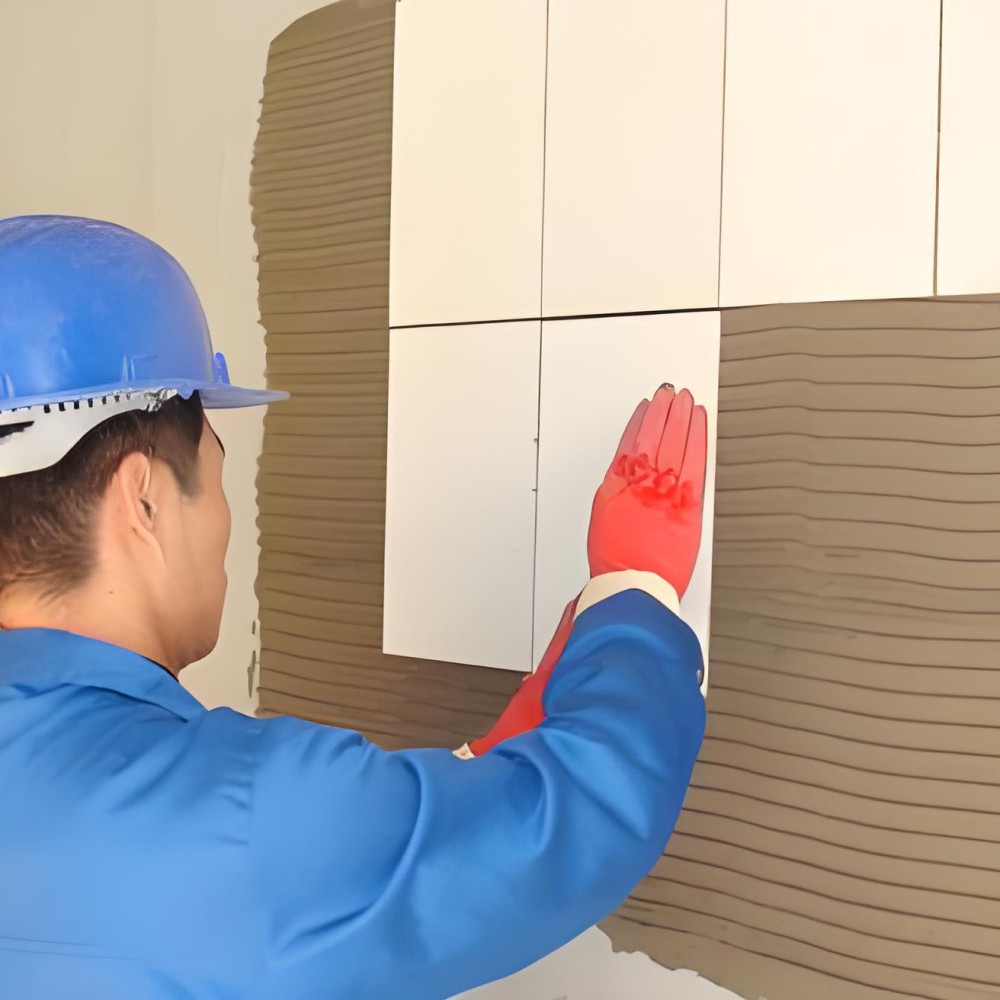
- Controlling Glue Coating Area and Method: The single glue coating area should match the construction speed, usually not exceeding 1㎡, to prevent the adhesive from losing viscosity due to long-term exposure. When applying glue, a toothed scraper (the tooth specification is 6mm×6mm or 8mm×8mm, determined by the tile size) should be used to comb tooth marks in the same direction, ensuring that excess adhesive can be squeezed out during laying to form a full bonding layer and reduce hollowing.
- Prohibiting Overnight Adhesive: The usable time of tile adhesive after mixing is 1-2 hours (depending on temperature and humidity). Beyond this period, it will initially set, and the bonding strength will drop sharply. Forced use will easily cause the tiles to fall off. During construction, the adhesive should be mixed as needed to avoid waste and quality hazards.
- Timely Inspection and Maintenance: The hollowing of tiles should be checked within 24 hours after laying. If the hollowing area exceeds 5%, rework is required; treading and water contact should be avoided within 24 hours of maintenance at room temperature to ensure that the adhesive is fully cured and forms stable bonding strength.